



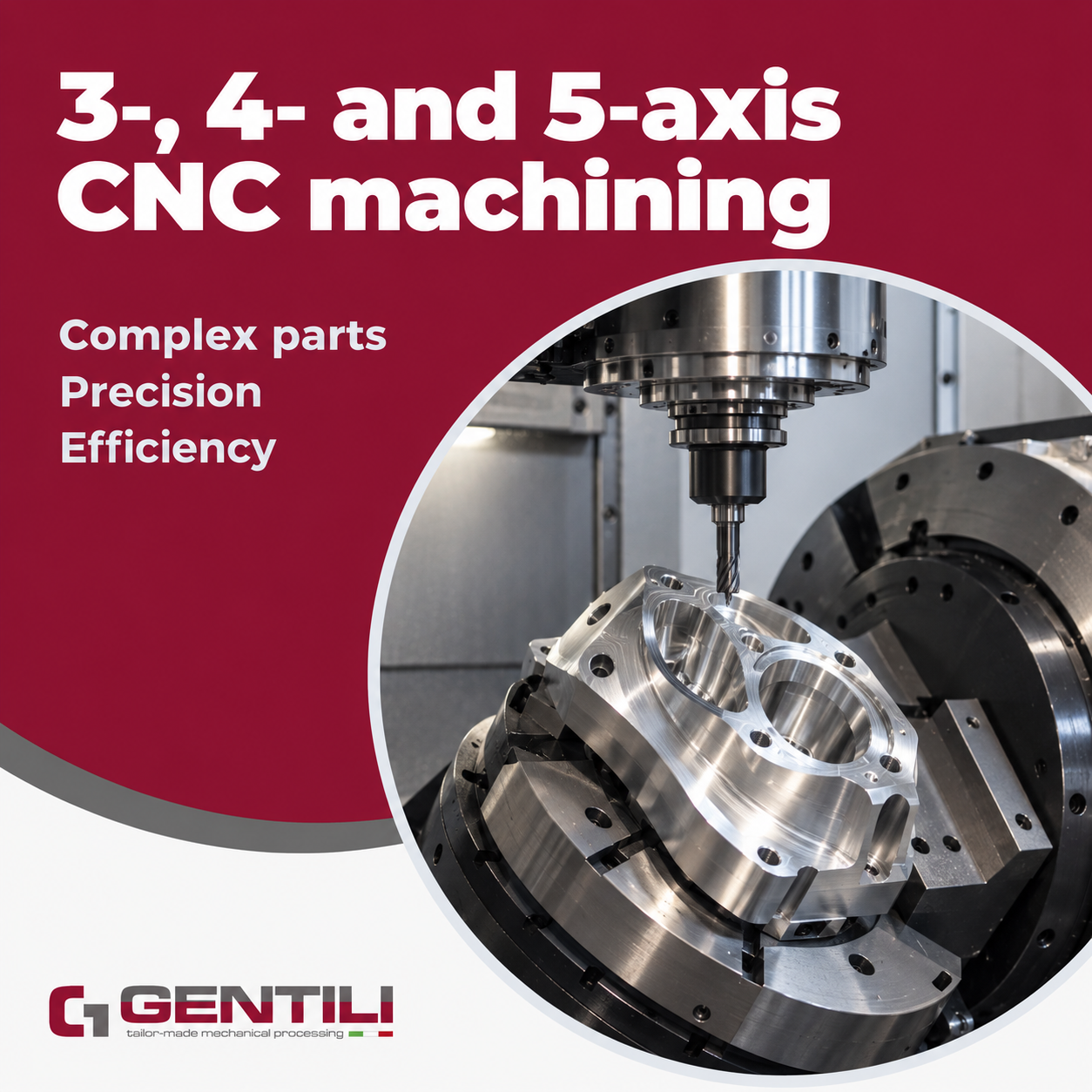
In precision manufacturing, more axes do not automatically mean a better process.
The right CNC machining strategy depends on the geometry of the component, the material, the tolerances required, the number of surfaces to be machined and the production volume.
For some components, a 3-axis machining centre provides the most efficient solution. Other geometries can benefit from 4-axis machining, while particularly complex parts may require the greater accessibility and flexibility offered by 5-axis CNC technology.
Understanding the differences between these processes is therefore essential when designing and manufacturing custom industrial components.
What does the number of CNC axes mean?
A CNC machining centre removes material using movements controlled by numerical instructions.
In a conventional 3-axis machine, movement takes place along three linear directions:
-
X-axis – left and right;
-
Y-axis – forwards and backwards;
-
Z-axis – up and down.
Adding further axes introduces rotational movement of either the workpiece or the machining head.
This allows the cutting tool to access the component from additional angles and can significantly reduce the need to manually reposition the part during production.
The choice between 3-, 4- and 5-axis machining therefore mainly concerns one fundamental question:
How can the required geometry be manufactured accurately and efficiently with the minimum number of setups?
3-axis CNC machining: efficient for many industrial components
3-axis CNC machining is one of the most widely used processes for milling industrial components.
The tool moves along the X, Y and Z axes while the workpiece remains in a fixed position.
This configuration is particularly effective for components with relatively straightforward geometries, where machining operations can be performed mainly from one direction.
Typical applications can include:
-
plates;
-
supports;
-
spacers;
-
guides;
-
blocks;
-
pockets;
-
slots;
-
holes;
-
profiles;
-
flat or moderately complex surfaces.
3-axis machining can deliver excellent precision and repeatability while keeping the machining process relatively simple.
For many industrial components, using additional axes would provide little practical advantage.
The objective is therefore not to use the most sophisticated machine available, but to select the most efficient production method for the component being manufactured.
When does 4-axis CNC machining become useful?
4-axis machining adds a rotational axis to the three conventional linear axes.
This allows the workpiece to rotate during the machining cycle, giving the tool access to different sides of the component without requiring repeated manual repositioning.
This capability can be particularly useful when features must be machined around the perimeter of a part.
Examples may include components requiring:
-
holes on different sides;
-
radial holes;
-
multiple lateral surfaces;
-
slots distributed around a component;
-
profiles positioned at different angles;
-
cylindrical or partially cylindrical geometries.
Reducing the number of manual setups is an important advantage.
Every time a component is removed, repositioned and clamped again, additional variables are introduced into the manufacturing process.
When the geometry allows it, 4-axis machining can therefore help improve productivity, consistency and dimensional accuracy.
5-axis CNC machining for complex geometries
5-axis CNC machining provides movement along three linear axes combined with two rotational axes.
This enables the cutting tool to approach the component from a much wider range of directions.
Depending on the machine configuration and machining strategy, the additional axes can be used for positioning or for coordinated multi-axis machining.
The main advantage is accessibility.
Complex surfaces and features that would otherwise require several setups can often be machined while keeping the component clamped in the same reference position.
This makes 5-axis technology particularly valuable for parts featuring:
-
complex three-dimensional geometries;
-
inclined surfaces;
-
angled holes;
-
multiple machined faces;
-
deep or difficult-to-reach areas;
-
complex contours;
-
tight relationships between features positioned on different surfaces.
For suitable components, fewer setups can translate into greater process efficiency and better control of dimensional relationships between different machined features.
Fewer setups can mean greater consistency
One of the most important considerations when selecting a CNC machining strategy is the number of times the component must be repositioned.
Suppose a part needs machining on five different sides.
With a conventional process, the operator may need to machine one surface, remove the part, reposition it, establish a new reference and start another operation.
This process can be perfectly appropriate for many components.
However, as geometrical complexity and tolerance requirements increase, reducing the number of setups becomes increasingly valuable.
Using 4- or 5-axis machining where appropriate can help reduce:
-
manual repositioning;
-
repeated clamping operations;
-
setup time;
-
potential alignment variations;
-
intermediate handling.
The advantage is not simply faster machining.
It is the possibility of creating a more controlled and repeatable production process.
Geometry determines the machining strategy
The appearance of a component alone does not determine which CNC technology should be used.
A relatively simple-looking part may require sophisticated machining because of a specific tolerance, an angled feature or the relationship between different surfaces.
Conversely, a visually complex component may sometimes be efficiently manufactured using carefully planned 3-axis operations.
For this reason, machining strategy should consider the complete technical drawing.
Important factors include:
Component geometry
How many surfaces must be machined and from which directions?
Accessibility
Can the cutting tool reach every required feature without interference?
Tolerances
Which dimensions and geometrical relationships are critical?
Material
Different materials require different cutting parameters, tools and machining strategies.
Surface requirements
Which surfaces are functional and what level of finish is required?
Batch size
Setup time becomes particularly important when managing prototypes, small batches or recurring production.
Production efficiency
The technically possible solution is not necessarily the most cost-effective one.
Machining technical plastics requires specific expertise
The machining strategy becomes even more important when working with technical plastics and engineering polymers.
Plastic materials behave differently from metals during cutting.
Depending on the polymer, factors such as heat generation, thermal expansion, elasticity, internal stresses, chip evacuation and clamping forces can influence the final result.
A machining strategy must therefore consider not only the geometry of the component but also the characteristics of the material.
This is particularly important when manufacturing precision components with thin walls, complex shapes, tight dimensional requirements or multiple machined surfaces.
The combination of appropriate CNC technology, suitable tooling and material-specific know-how is essential to obtain consistent results.
From drawing to finished component
Choosing between 3-, 4- and 5-axis machining should therefore happen within a broader evaluation of the component.
The customer's technical drawing defines the functional requirements.
From there, the manufacturing process must determine the most appropriate combination of:
-
machine technology;
-
workpiece positioning;
-
machining sequence;
-
cutting tools;
-
operating parameters;
-
dimensional controls.
Gentili S.r.l. combines more than 50 years of manufacturing experience with advanced technologies for the machining of technical plastics, phenolic laminates and light alloys. The company's production equipment includes 3-, 4- and 5-axis CNC machining centres, with dedicated departments for milling, drilling, cutting, assembly and quality control.
This flexibility allows the manufacturing process to be selected according to the actual requirements of each component rather than applying the same production method to every project.
Quality control completes the machining process
Precision machining does not end when the component leaves the CNC machine.
Dimensional verification is an essential part of manufacturing technical components.
Gentili's Quality Control department uses Industry 4.0 measurement technologies, including a high-precision digital height gauge and a three-dimensional measuring arm, to verify manufactured components according to individual order requirements.
Gentili also operates under an ISO 9001:2015 certified quality management system, supporting process control, traceability and compliance with customer specifications.
The right CNC process is the one that fits the component
3-, 4- and 5-axis machining should not be seen as competing technologies.
They are different tools for solving different manufacturing requirements.
A well-designed 3-axis process may be the fastest and most economical solution for one component.
A 4-axis approach may eliminate unnecessary repositioning for another.
For a highly complex part, 5-axis machining may provide the access and process control required to manufacture multiple surfaces in fewer setups.
The key is selecting the machining strategy around the geometry, material, tolerances and function of the component.
This is where manufacturing experience becomes just as important as machine technology.
Do you need a custom-machined component?
Gentili S.r.l. manufactures components according to customer drawings and specifications using technical plastics, phenolic laminates and light alloys.
From prototypes and small batches to recurring industrial production, the most appropriate machining strategy can be selected according to the requirements of each project.
Contact Gentili to discuss your component or request a quotation.