Select your language

  • Italiano (it-IT)
  • English (United Kingdom)
  • +39 0544 554082
  • info@gentilisrl.eu
Gentili srl Gentili srl
  • COMPANY
    • HISTORY
    • CERTIFICATIONS
    • WHO WE ARE
  • PRODUCTION
  • CERTIFICATIONS
  • SUSTAINABILITY
  • BLOG
  • CONTACT
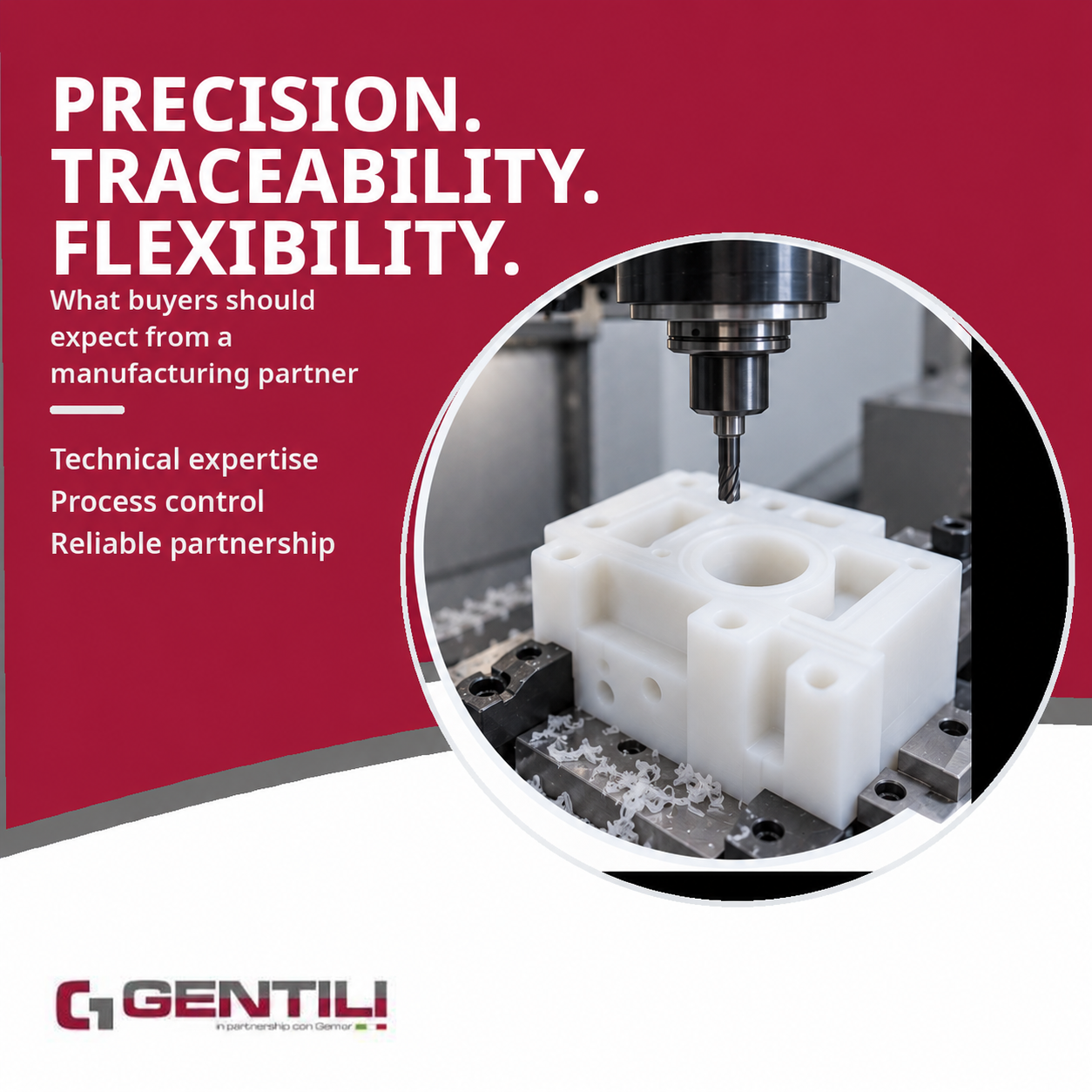
Precision, traceability and flexibility: what buyers should expect from a manufacturing partner

Precision, traceability and flexibility: what buyers should expect from a manufacturing partner

BLOG 10 June 2026

Selecting a manufacturing supplier involves much more than comparing quotations.

For technical and procurement departments, the real question is whether a supplier can consistently manufacture the required component, control the process, adapt to changing requirements and provide reliable support throughout the relationship.

In customized industrial manufacturing, three factors are particularly important:

precision, traceability and flexibility.

Together, they provide a useful framework for evaluating a potential manufacturing partner.

1. Precision: can the supplier reproduce the drawing?

Every sourcing process begins with a technical requirement.

The manufacturing supplier must be able to translate that requirement into a physical component while respecting:

  • geometry;
  • dimensions;
  • tolerances;
  • material specifications;
  • surface requirements;
  • functional characteristics.

Machine technology is clearly important.

Gentili's production equipment includes 3-, 4- and 5-axis CNC machining centres for customized components in technical plastics, phenolic laminates and light alloys.

But machining equipment alone does not guarantee precision.

The process must also consider tooling, workpiece positioning, machining strategy and material behaviour.

This is particularly relevant when working with technical plastics, which require specific manufacturing expertise.

Precision must be verified

For a buyer, the manufacturer's claim of precision is less important than its ability to verify it.

This is where quality control becomes essential.

Gentili uses Quality Control 4.0 equipment including a high-precision digital height gauge and a 3D measuring arm to support dimensional verification of manufactured components.

Digital inspection helps create a more structured relationship between the technical drawing and the finished component.

For procurement and engineering teams, this reduces uncertainty.

2. Traceability: can the component be identified?

Industrial supply chains increasingly require reliable identification.

A technical component may remain in service for years.

During that period it may need to be inspected, replaced, reordered or associated with technical documentation.

Traceability supports these activities.

Gentili operates a dedicated industrial marking department with fiber and UV laser, CO₂ laser and micro-dot marking technologies.

Permanent identification can support:

  • component recognition;
  • part-number management;
  • maintenance;
  • batch management;
  • spare-parts operations;
  • internal quality procedures.

Traceability therefore connects manufacturing with the entire lifecycle of the component.

Process traceability matters too

Traceability is not limited to physically marking a part.

It also involves the way the manufacturing process itself is managed.

A structured quality system helps ensure that specifications, procedures and controls are handled consistently.

Gentili operates under an ISO 9001:2015 certified quality management system, which supports rigorous process control, continuous improvement and traceability.

For buyers, this is particularly important when the supplier relationship becomes recurring rather than limited to a single order.

3. Flexibility: can the supplier adapt?

Not every industrial project follows a predictable pattern.

Volumes change.

Drawings evolve.

Prototypes become small production batches.

Components may require modifications.

New materials or additional operations may become necessary.

For companies operating in specialized industries, manufacturing flexibility can therefore be just as important as production capacity.

Gentili's organization is focused on tailor-made mechanical processing, technical components and small-series production.

The company's production capabilities include:

  • milling;
  • drilling;
  • cutting;
  • prototyping;
  • multi-axis CNC machining;
  • quality control;
  • industrial marking;
  • customized kit assembly.

This range of capabilities makes it possible to organize the production process around the requirements of the project.

Look beyond the individual machine

When evaluating a supplier, it can be tempting to focus exclusively on its machinery.

Which CNC centres does it have?

How many axes?

What technology does it use?

These are important questions, but they provide only part of the answer.

A manufacturing partner should also be evaluated on how its different processes work together.

For example:

Machining + inspection
Can the supplier manufacture the component and verify critical dimensions?

Machining + marking
Can identification be integrated without involving another supplier?

Machining + assembly
Can several components be supplied as a coordinated kit?

Prototyping + small batches
Can the supplier support the project as requirements evolve?

The more effectively these activities are coordinated, the easier the overall supply relationship can become.

Fewer handovers, more control

Every additional production step managed externally can create another supplier interface.

For purchasing departments, that means additional:

  • quotations;
  • orders;
  • deliveries;
  • controls;
  • logistics;
  • administration;
  • communication.

Consolidating compatible activities within one manufacturing partner can simplify this chain.

Gentili has dedicated areas for milling, drilling, cutting, assembly and quality control and integrates these operations within a tailor-made production approach.

The advantage is not simply convenience.

It can provide greater continuity from drawing to finished component.

Technical communication is part of the service

A good manufacturing relationship also depends on communication.

Buyers and engineers need a supplier capable of understanding:

  • drawings;
  • functional requirements;
  • critical tolerances;
  • production quantities;
  • application constraints;
  • required documentation.

This becomes especially important when manufacturing customized parts.

An efficient supplier relationship should help identify potential production issues before they become problems.

For this reason, technical responsiveness should be considered alongside price and lead time when qualifying a new partner.

Quality and responsible production

Today, companies are also increasingly looking at how suppliers manage their wider responsibilities.

Gentili publishes an annual Sustainability Report and states that its sustainability approach covers people, ethical relationships with customers and suppliers, continuous improvement and reduction of the environmental impact of its manufacturing processes.

The company also describes an ongoing path toward reducing its carbon footprint and strengthening its environmental-management approach.

For procurement teams, these elements are becoming increasingly relevant when evaluating long-term supply relationships.

What should a buyer ask?

When qualifying a manufacturing supplier, a useful checklist includes:

  • Can you manufacture the required geometry?
  • Which materials do you regularly machine?
  • How are critical dimensions inspected?
  • Can components be permanently identified?
  • How do you manage traceability?
  • Can you support prototypes and small batches?
  • Can you manage component assembly?
  • Which quality-management standards are in place?
  • How are changes to specifications handled?
  • Can several operations be managed within the same production workflow?

Price remains important.

But these questions help determine the real value and risk of the supply relationship.

From supplier to manufacturing partner

The strongest industrial relationships are not based on a single purchase order.

They are built when the supplier understands the customer's technical requirements and can provide consistent support as those requirements evolve.

Precision ensures that the component meets its specification.

Traceability keeps the component and its process identifiable.

Flexibility allows production to respond to changing needs.

Together, these capabilities help transform a conventional supplier into a reliable manufacturing partner.

Gentili S.r.l. has provided tailor-made mechanical processing since 1974, combining more than 50 years of manufacturing experience with specialized production technologies for technical plastics, phenolic laminates and light alloys.

Looking for a manufacturing partner for your next project?

From prototypes and small batches to complex components, marking, inspection and customized assemblies, Gentili builds the production process around the customer's technical requirements.

Send us your drawing or request a technical evaluation.
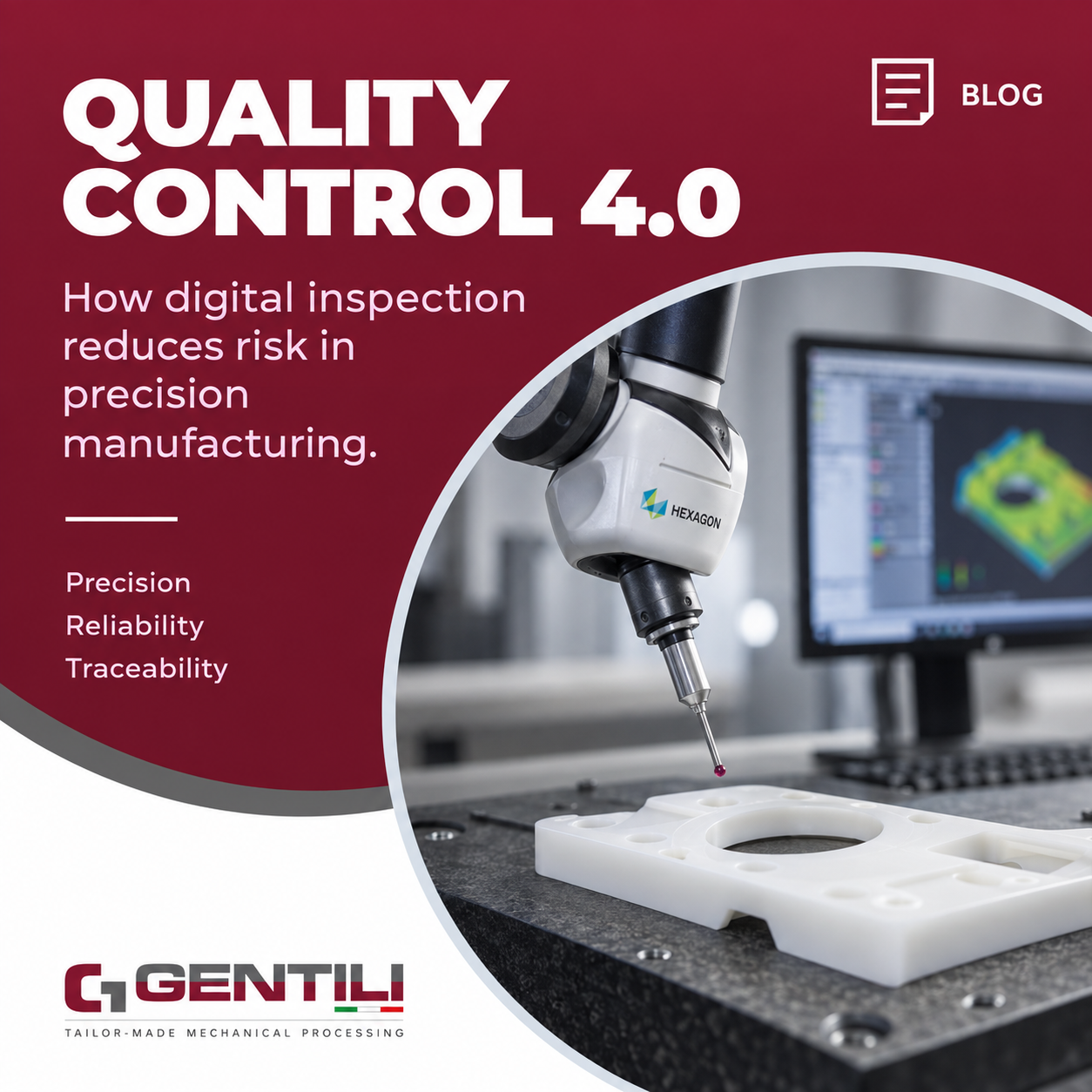
Quality Control 4.0: how digital inspection reduces risk in precision manufacturing

Quality Control 4.0: how digital inspection reduces risk in precision manufacturing

BLOG 12 March 2026

In precision manufacturing, producing a component is only part of the job. The other essential step is verifying that the finished part actually meets the required dimensions, tolerances and functional specifications.

As components become more complex and industrial customers demand greater consistency, digital dimensional inspection plays an increasingly important role in reducing manufacturing risk.

Quality Control 4.0 combines measurement technologies, digital data and structured verification processes to provide manufacturers and their customers with greater confidence in the final component.

At Gentili S.r.l., quality control is integrated into the production process and supported by Industry 4.0 measurement technologies, including a high-precision digital height gauge and a 3D measuring arm.

Why dimensional inspection matters

A component may look correct but still fail to perform as expected if a critical dimension is outside tolerance.

In industrial machinery, even relatively small dimensional deviations can affect:

  • assembly;
  • alignment;
  • movement;
  • sealing;
  • positioning;
  • interaction with other components;
  • long-term reliability.

This becomes particularly important when manufacturing customized components designed to work inside complex production systems.

For this reason, dimensional inspection should not be considered a final formality. It is part of the manufacturing process itself.

From traditional measurement to digital inspection

Conventional measuring tools remain useful for many operations.

However, increasingly complex geometries require more advanced systems capable of checking dimensions and relationships that may be difficult to verify using basic manual instruments alone.

Digital inspection equipment can support the measurement of:

  • heights;
  • distances;
  • diameters;
  • hole positions;
  • profiles;
  • angles;
  • geometric relationships between different surfaces;
  • three-dimensional features.

The main advantage is not simply greater technological sophistication.

It is the ability to obtain more structured, repeatable and reliable dimensional information.

The role of 3D measurement

Complex components often contain features positioned on several different planes.

A traditional measurement approach may require multiple operations to verify them.

A three-dimensional measuring system provides greater flexibility because measurements can be taken from different areas of the component while maintaining a common geometric reference.

This is particularly useful for parts manufactured using multi-axis CNC machining, where several surfaces and features may need to maintain precise relationships with one another.

For technical teams, the value is clear: the component is not evaluated only as a collection of individual dimensions but as a complete geometry.

Reducing the risk of non-conforming parts

One of the main objectives of quality control is to detect dimensional deviations before a component reaches the customer's production line.

An incorrect component can generate costs far beyond its manufacturing value.

Potential consequences include:

  • assembly delays;
  • machine downtime;
  • additional inspections;
  • reworking;
  • replacement parts;
  • production interruptions;
  • additional logistics;
  • supplier management issues.

An effective inspection process helps identify problems earlier.

In this sense, quality control is also a form of risk management.

The earlier a deviation is identified, the easier it is to correct the process and prevent the same problem from affecting additional components.

Inspection and repeatability

A single component within tolerance is not enough.

For recurring production and small batches, customers need consistency from one component to the next.

Digital inspection helps manufacturers verify whether the machining process is producing stable results over time.

This becomes especially important when working with technical plastics.

Engineering polymers can behave differently from metals during machining because of factors such as temperature, material elasticity, internal stresses and clamping conditions.

A controlled manufacturing and inspection strategy therefore helps ensure that the final dimensions remain consistent with the technical requirements.

Traceability supports quality

Quality control is closely connected to traceability.

Knowing how a component was manufactured, checked and identified makes it easier to manage production history and customer requirements.

For buyers and quality departments, this provides an additional layer of confidence.

Gentili operates under an ISO 9001:2015 certified quality management system, focused on rigorous process control, continuous improvement, traceability and compliance with customer specifications.

This structured approach complements the physical measurement of the component.

Quality is therefore created through both production control and verification.

Quality Control 4.0 and custom manufacturing

Quality inspection becomes particularly valuable in tailor-made production.

Unlike mass-produced standard items, customized industrial components are often developed according to individual technical drawings and specific functional requirements.

Each order can therefore involve different:

  • dimensions;
  • tolerances;
  • materials;
  • geometries;
  • quantities;
  • inspection requirements.

A flexible digital quality-control department makes it possible to adapt the verification process to the characteristics of each project.

Gentili manufactures custom components in technical plastics, phenolic laminates and light alloys and has dedicated areas for machining, assembly and quality control.

Quality is part of the manufacturing process

Modern quality control is no longer simply about checking components at the end of production.

It means creating a controlled workflow in which machining and inspection support each other.

Digital dimensional inspection helps manufacturers:

  • verify complex geometries;
  • monitor critical dimensions;
  • improve repeatability;
  • identify deviations earlier;
  • document production quality;
  • reduce the risk associated with non-conforming components.

For industrial customers, this translates into something very practical: greater confidence that the component received will perform as expected when it reaches the assembly line.

Need precision components with controlled dimensional inspection?

Gentili S.r.l. combines CNC machining, specialized production areas and Quality Control 4.0 technologies to manufacture components according to customer drawings and specifications.

Contact Gentili to discuss your technical requirements.

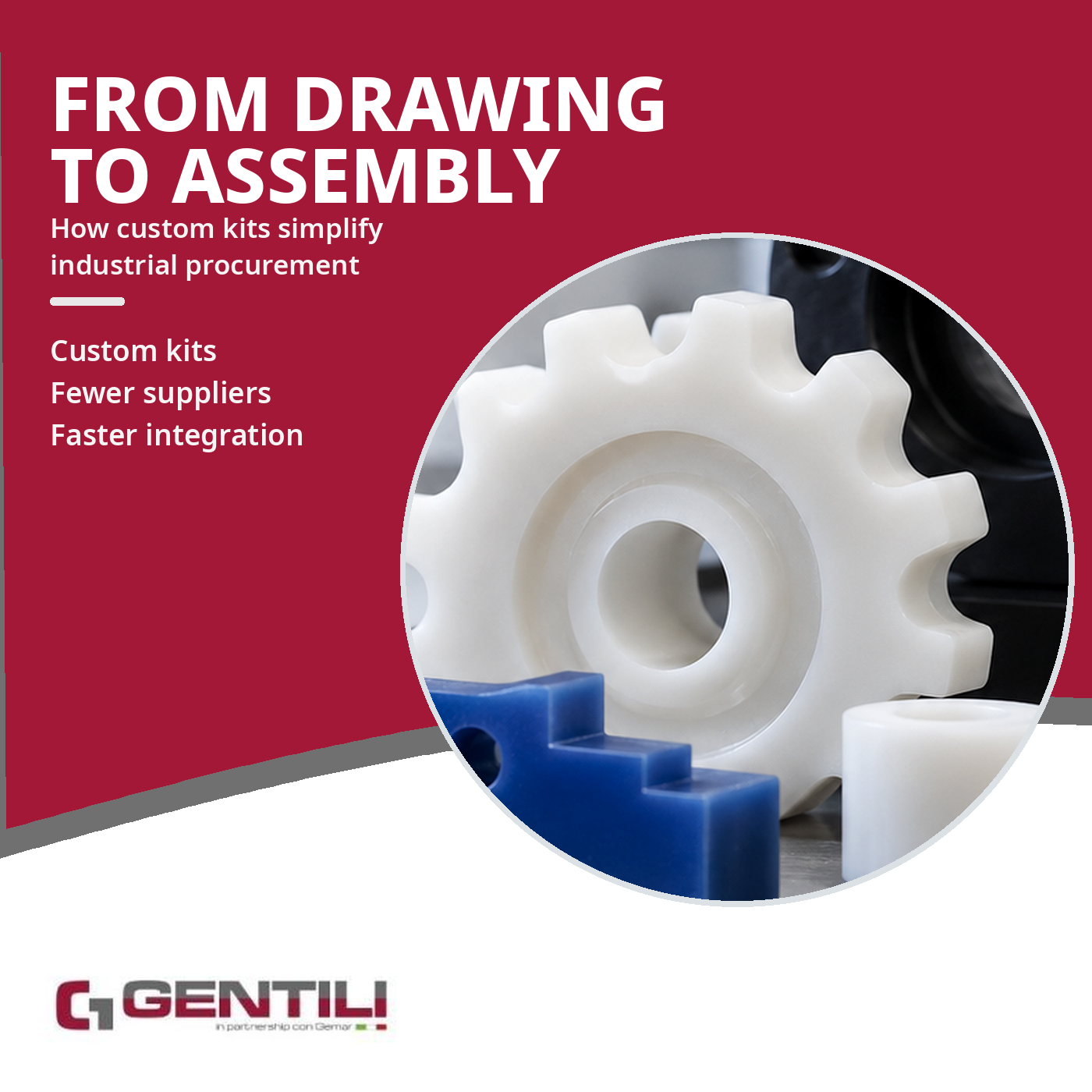
From drawing to assembly: how custom kits simplify industrial procurement

From drawing to assembly: how custom kits simplify industrial procurement

BLOG 13 May 2026

For industrial buyers, purchasing individual components is only one part of managing the supply chain.

A project may involve several machined parts, different materials, quality inspections and final assembly operations before the components are ready to enter the production line.

Every additional supplier and every additional handover creates another activity to manage.

For this reason, custom kit assembly can offer significant advantages when technical components need to arrive as a coordinated, ready-to-integrate solution.

Gentili S.r.l. combines customized machining with assembly capabilities for plastic and metal kits developed according to customer specifications.

The limits of component-by-component procurement

Consider a technical assembly made from several custom components.

The purchasing department may need to source different parts, monitor delivery dates, verify incoming products, manage inventory and coordinate internal assembly.

The engineering team may then need to confirm that all components fit correctly together.

When several suppliers are involved, complexity increases further.

Potential issues include:

  • different production lead times;
  • multiple purchase orders;
  • separate shipments;
  • duplicated quality controls;
  • component compatibility problems;
  • increased inventory;
  • greater administrative work.

None of these activities adds direct value to the finished machine.

They are necessary because the supply process has been fragmented.

From individual component to customized kit

A custom kit changes the approach.

Instead of treating every part as an independent purchase, several components are managed as elements of the same technical requirement.

The supplier can manufacture, control and assemble them according to the customer's specifications.

Gentili has dedicated production areas for milling, drilling, cutting, assembly and quality control, as well as assembly benches for customized kits.

This creates a more integrated workflow from technical drawing to finished assembly.

One technical drawing, one controlled process

The process begins with the customer's specifications.

Different components may require different materials, manufacturing methods and tolerances.

For example, a kit might combine:

  • technical plastic parts;
  • light-alloy components;
  • machined plates;
  • supports;
  • spacers;
  • guides;
  • fasteners or complementary elements.

Each component can be manufactured individually and then brought together during the assembly stage.

The advantage is that compatibility can be evaluated before the complete kit reaches the customer.

Fewer supplier handovers

Supplier consolidation is one of the most important potential benefits for procurement departments.

Imagine a project requiring five custom components.

If the parts are managed separately, the buyer may need to coordinate several orders or suppliers.

When manufacturing and kit assembly are integrated, the customer can manage a broader part of the requirement through a single technical relationship.

This can reduce:

  • purchase-order complexity;
  • supplier coordination;
  • transport between suppliers;
  • incoming logistics;
  • internal handling;
  • communication steps.

The result is a simpler supply chain.

Assembly can reveal problems earlier

There is another important advantage.

When components are assembled before delivery, compatibility problems can potentially be detected earlier.

Two parts may individually meet their dimensional requirements but still require careful evaluation when they interact within an assembly.

Integrating machining, dimensional inspection and assembly makes it possible to consider the components as part of a complete system.

Gentili's production organization combines customized machining, digital quality inspection, marking and assembly within dedicated production areas.

Supporting leaner production lines

Custom kits can also help customers simplify their internal processes.

Instead of receiving several separate component references, the production department may receive a coordinated group of parts ready for the next assembly stage.

This can potentially reduce:

  • picking activities;
  • internal transport;
  • component sorting;
  • intermediate inventories;
  • assembly preparation.

The exact benefits depend on the customer's production system, but the principle is straightforward:

move selected operations upstream to a specialized supplier so that the customer's production line can focus on higher-value activities.

Flexibility matters in small-series manufacturing

Kit assembly is particularly relevant when production requirements are customized or volumes are limited.

Mass-production supply chains are usually built around highly standardized operations.

Technical machinery manufacturers often work differently.

They may require:

  • prototypes;
  • customized components;
  • project-specific assemblies;
  • small production batches;
  • recurring but variable quantities.

Gentili describes its manufacturing model as flexible and focused on technical components and small-series production for specialized industries.

This type of organization makes it possible to adapt the workflow according to individual projects.

Quality control before assembly

A kit is only as reliable as the components inside it.

For this reason, dimensional inspection remains an important part of an integrated production process.

Gentili's Quality Control 4.0 department uses digital inspection technologies including a precision digital height gauge and a three-dimensional measuring arm.

Verification before or during assembly can help ensure that the individual components meet the requirements defined by the project.

Gentili's ISO 9001:2015 quality management system also supports process control and traceability throughout production.

A procurement decision, not just a manufacturing decision

The value of custom kit assembly is therefore not limited to production.

It can also affect the purchasing strategy.

When evaluating a supplier, procurement departments should consider not only the price of individual parts but the total effort required to obtain a usable assembly.

That includes:

  • supplier management;
  • logistics;
  • inspection;
  • inventory;
  • internal assembly;
  • administrative work;
  • risk of mismatched components.

A supplier capable of managing more stages of the process may help reduce this complexity.

From drawing to ready-to-integrate solution

The most effective industrial supply relationships go beyond simply delivering components.

They start with an understanding of the technical requirement and build the production process around it.

Gentili combines custom machining, prototyping, quality control, marking and kit assembly for technical plastics and light alloys.

For customers, this provides the possibility of moving from a series of individual purchases toward a more coordinated manufacturing solution.

Can your component supply be simplified?

Gentili S.r.l. manufactures customized components and assemblies according to customer specifications.

Send us your drawings and technical requirements to evaluate a tailored production and assembly solution.

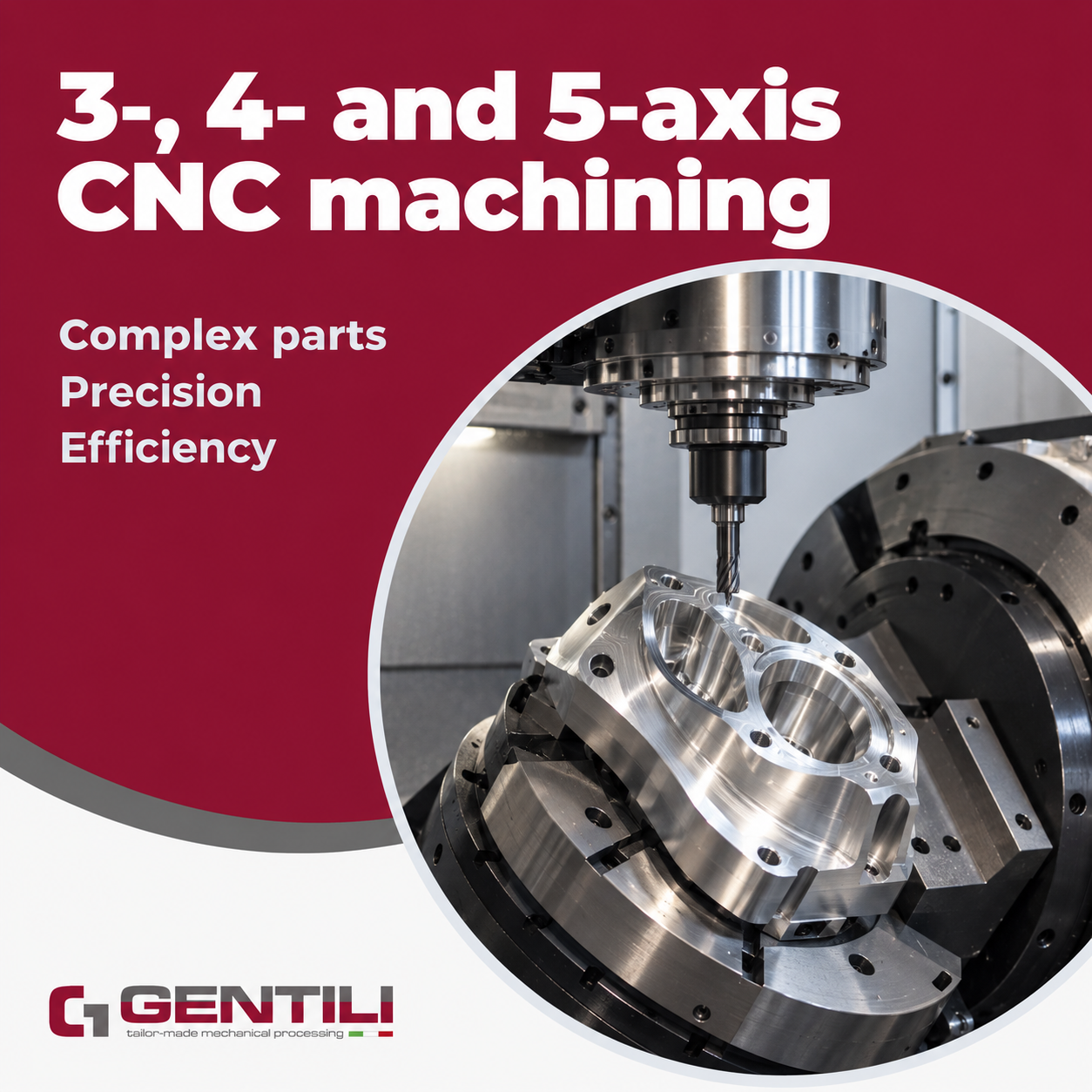
3-, 4- and 5-axis CNC machining: choosing the right process for complex parts

3-, 4- and 5-axis CNC machining: choosing the right process for complex parts

BLOG 12 February 2026

In precision manufacturing, more axes do not automatically mean a better process.

The right CNC machining strategy depends on the geometry of the component, the material, the tolerances required, the number of surfaces to be machined and the production volume.

For some components, a 3-axis machining centre provides the most efficient solution. Other geometries can benefit from 4-axis machining, while particularly complex parts may require the greater accessibility and flexibility offered by 5-axis CNC technology.

Understanding the differences between these processes is therefore essential when designing and manufacturing custom industrial components.

What does the number of CNC axes mean?

A CNC machining centre removes material using movements controlled by numerical instructions.

In a conventional 3-axis machine, movement takes place along three linear directions:

  • X-axis – left and right;

  • Y-axis – forwards and backwards;

  • Z-axis – up and down.

Adding further axes introduces rotational movement of either the workpiece or the machining head.

This allows the cutting tool to access the component from additional angles and can significantly reduce the need to manually reposition the part during production.

The choice between 3-, 4- and 5-axis machining therefore mainly concerns one fundamental question:

How can the required geometry be manufactured accurately and efficiently with the minimum number of setups?

3-axis CNC machining: efficient for many industrial components

3-axis CNC machining is one of the most widely used processes for milling industrial components.

The tool moves along the X, Y and Z axes while the workpiece remains in a fixed position.

This configuration is particularly effective for components with relatively straightforward geometries, where machining operations can be performed mainly from one direction.

Typical applications can include:

  • plates;

  • supports;

  • spacers;

  • guides;

  • blocks;

  • pockets;

  • slots;

  • holes;

  • profiles;

  • flat or moderately complex surfaces.

3-axis machining can deliver excellent precision and repeatability while keeping the machining process relatively simple.

For many industrial components, using additional axes would provide little practical advantage.

The objective is therefore not to use the most sophisticated machine available, but to select the most efficient production method for the component being manufactured.

When does 4-axis CNC machining become useful?

4-axis machining adds a rotational axis to the three conventional linear axes.

This allows the workpiece to rotate during the machining cycle, giving the tool access to different sides of the component without requiring repeated manual repositioning.

This capability can be particularly useful when features must be machined around the perimeter of a part.

Examples may include components requiring:

  • holes on different sides;

  • radial holes;

  • multiple lateral surfaces;

  • slots distributed around a component;

  • profiles positioned at different angles;

  • cylindrical or partially cylindrical geometries.

Reducing the number of manual setups is an important advantage.

Every time a component is removed, repositioned and clamped again, additional variables are introduced into the manufacturing process.

When the geometry allows it, 4-axis machining can therefore help improve productivity, consistency and dimensional accuracy.

5-axis CNC machining for complex geometries

5-axis CNC machining provides movement along three linear axes combined with two rotational axes.

This enables the cutting tool to approach the component from a much wider range of directions.

Depending on the machine configuration and machining strategy, the additional axes can be used for positioning or for coordinated multi-axis machining.

The main advantage is accessibility.

Complex surfaces and features that would otherwise require several setups can often be machined while keeping the component clamped in the same reference position.

This makes 5-axis technology particularly valuable for parts featuring:

  • complex three-dimensional geometries;

  • inclined surfaces;

  • angled holes;

  • multiple machined faces;

  • deep or difficult-to-reach areas;

  • complex contours;

  • tight relationships between features positioned on different surfaces.

For suitable components, fewer setups can translate into greater process efficiency and better control of dimensional relationships between different machined features.

Fewer setups can mean greater consistency

One of the most important considerations when selecting a CNC machining strategy is the number of times the component must be repositioned.

Suppose a part needs machining on five different sides.

With a conventional process, the operator may need to machine one surface, remove the part, reposition it, establish a new reference and start another operation.

This process can be perfectly appropriate for many components.

However, as geometrical complexity and tolerance requirements increase, reducing the number of setups becomes increasingly valuable.

Using 4- or 5-axis machining where appropriate can help reduce:

  • manual repositioning;

  • repeated clamping operations;

  • setup time;

  • potential alignment variations;

  • intermediate handling.

The advantage is not simply faster machining.

It is the possibility of creating a more controlled and repeatable production process.

Geometry determines the machining strategy

The appearance of a component alone does not determine which CNC technology should be used.

A relatively simple-looking part may require sophisticated machining because of a specific tolerance, an angled feature or the relationship between different surfaces.

Conversely, a visually complex component may sometimes be efficiently manufactured using carefully planned 3-axis operations.

For this reason, machining strategy should consider the complete technical drawing.

Important factors include:

Component geometry
How many surfaces must be machined and from which directions?

Accessibility
Can the cutting tool reach every required feature without interference?

Tolerances
Which dimensions and geometrical relationships are critical?

Material
Different materials require different cutting parameters, tools and machining strategies.

Surface requirements
Which surfaces are functional and what level of finish is required?

Batch size
Setup time becomes particularly important when managing prototypes, small batches or recurring production.

Production efficiency
The technically possible solution is not necessarily the most cost-effective one.

Machining technical plastics requires specific expertise

The machining strategy becomes even more important when working with technical plastics and engineering polymers.

Plastic materials behave differently from metals during cutting.

Depending on the polymer, factors such as heat generation, thermal expansion, elasticity, internal stresses, chip evacuation and clamping forces can influence the final result.

A machining strategy must therefore consider not only the geometry of the component but also the characteristics of the material.

This is particularly important when manufacturing precision components with thin walls, complex shapes, tight dimensional requirements or multiple machined surfaces.

The combination of appropriate CNC technology, suitable tooling and material-specific know-how is essential to obtain consistent results.

From drawing to finished component

Choosing between 3-, 4- and 5-axis machining should therefore happen within a broader evaluation of the component.

The customer's technical drawing defines the functional requirements.

From there, the manufacturing process must determine the most appropriate combination of:

  • machine technology;

  • workpiece positioning;

  • machining sequence;

  • cutting tools;

  • operating parameters;

  • dimensional controls.

Gentili S.r.l. combines more than 50 years of manufacturing experience with advanced technologies for the machining of technical plastics, phenolic laminates and light alloys. The company's production equipment includes 3-, 4- and 5-axis CNC machining centres, with dedicated departments for milling, drilling, cutting, assembly and quality control.

This flexibility allows the manufacturing process to be selected according to the actual requirements of each component rather than applying the same production method to every project.

Quality control completes the machining process

Precision machining does not end when the component leaves the CNC machine.

Dimensional verification is an essential part of manufacturing technical components.

Gentili's Quality Control department uses Industry 4.0 measurement technologies, including a high-precision digital height gauge and a three-dimensional measuring arm, to verify manufactured components according to individual order requirements.

Gentili also operates under an ISO 9001:2015 certified quality management system, supporting process control, traceability and compliance with customer specifications.

The right CNC process is the one that fits the component

3-, 4- and 5-axis machining should not be seen as competing technologies.

They are different tools for solving different manufacturing requirements.

A well-designed 3-axis process may be the fastest and most economical solution for one component.

A 4-axis approach may eliminate unnecessary repositioning for another.

For a highly complex part, 5-axis machining may provide the access and process control required to manufacture multiple surfaces in fewer setups.

The key is selecting the machining strategy around the geometry, material, tolerances and function of the component.

This is where manufacturing experience becomes just as important as machine technology.

Do you need a custom-machined component?

Gentili S.r.l. manufactures components according to customer drawings and specifications using technical plastics, phenolic laminates and light alloys.

From prototypes and small batches to recurring industrial production, the most appropriate machining strategy can be selected according to the requirements of each project.

Contact Gentili to discuss your component or request a quotation.

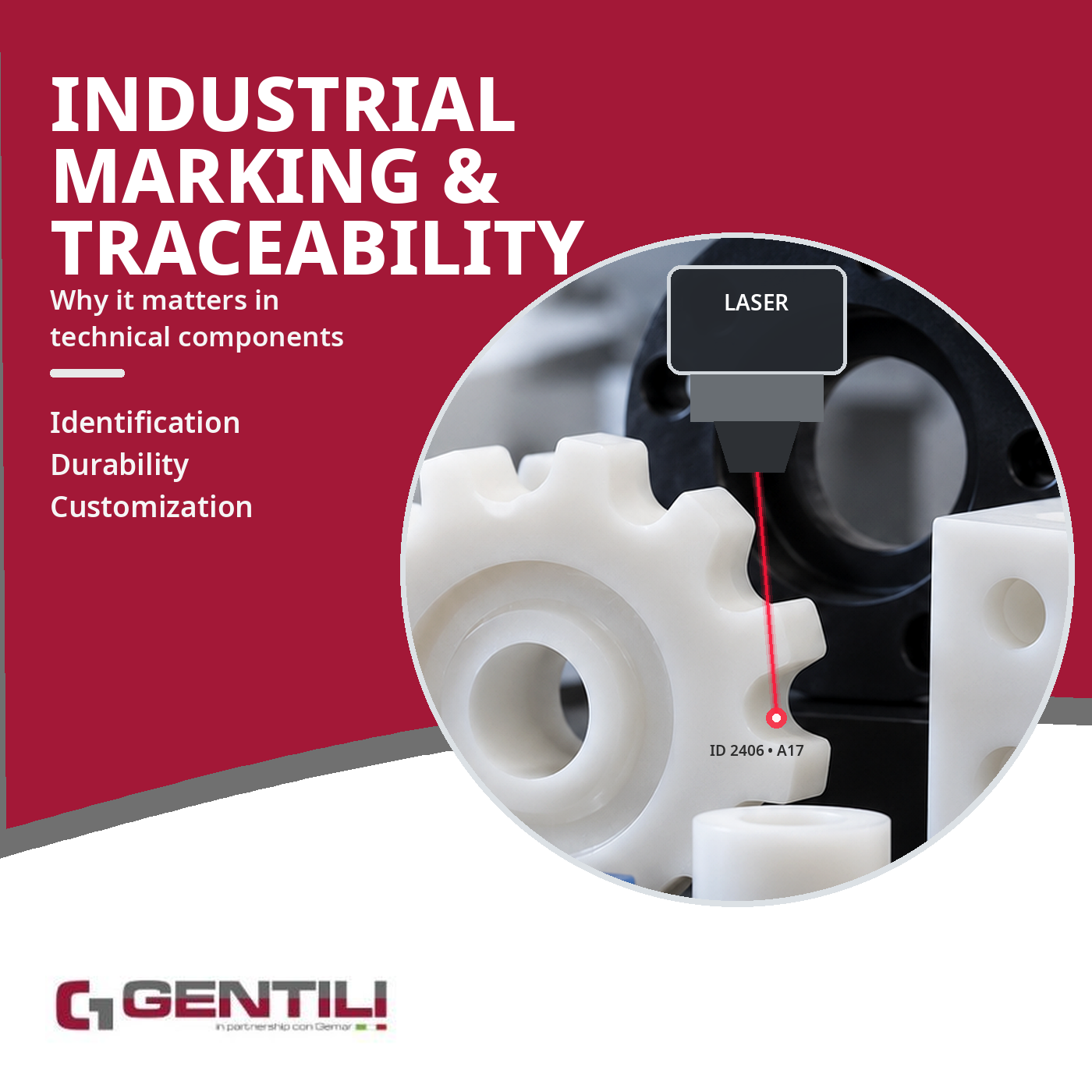
Industrial marking and traceability: why they matter in technical components

Industrial marking and traceability: why they matter in technical components

BLOG 10 April 2026

A technical component is defined not only by its geometry and material.

In many industrial applications, it must also be clearly identifiable throughout its lifecycle.

Part numbers, production references, codes, serial information and other permanent markings can help companies manage components from manufacturing and assembly to maintenance and replacement.

For this reason, industrial marking and component traceability are increasingly important elements of technical manufacturing.

Gentili S.r.l. operates a dedicated marking department offering fiber and UV laser marking, CO₂ laser marking and micro-dot marking for technical plastics and light alloys.

Why industrial components need identification

Modern production systems may contain hundreds or thousands of individual parts.

Some may look extremely similar while having different dimensions, materials or functions.

Clear identification helps reduce uncertainty.

Industrial marking can be used to add information such as:

  • part numbers;
  • internal codes;
  • customer codes;
  • serial numbers;
  • batch references;
  • logos;
  • symbols;
  • technical information;
  • assembly references;
  • machine-readable codes where applicable.

The specific information required depends on the application and the customer's internal traceability system.

Traceability starts with the component

Traceability is often associated with production databases or documentation.

However, the physical component itself can also play an important role.

A permanent marking creates a direct link between the part and the information associated with it.

This becomes particularly valuable during:

  • incoming inspection;
  • assembly;
  • installation;
  • maintenance;
  • spare-part management;
  • quality investigations;
  • component replacement.

Being able to identify a part directly can simplify communication between engineering, production, quality and maintenance departments.

Different materials require different marking technologies

There is no universal marking technology suitable for every material and every application.

The appropriate solution depends on several factors:

  • material;
  • surface;
  • required contrast;
  • marking depth;
  • component geometry;
  • durability requirements;
  • production volumes;
  • information to be marked.

This is why access to different technologies provides an important advantage.

Gentili's dedicated marking capabilities include fiber laser, UV laser, CO₂ laser and micro-dot technologies.

Each process can address different technical requirements.

Fiber laser marking

Fiber laser systems are widely used for industrial marking because they can create accurate, permanent markings on many suitable materials.

The process is highly controllable and can be used for detailed information, codes, text and identification elements.

For manufacturers, one advantage is the ability to create precise marks without adding labels or separate identification elements.

UV laser marking

UV laser technology can be useful when controlled interaction with the surface is particularly important.

It provides manufacturers with another option when working with materials or applications requiring fine, high-quality marking.

The choice between laser technologies should always be made according to the specific component and material.

CO₂ laser marking

CO₂ laser systems are frequently associated with the processing and marking of non-metallic materials.

For companies working with technical plastics, access to CO₂ technology broadens the range of possible applications.

Again, material compatibility and the required visual or functional result must be evaluated before selecting the process.

Micro-dot marking

Micro-dot — or dot-peen — marking creates identification by mechanically producing a sequence of controlled dots on the surface.

The technique can provide durable industrial identification and is suitable for applications where permanent physical marking is required.

Gentili has continued to invest in this area, expanding its production capabilities with new micro-dot marking equipment.

Why integrated marking matters to buyers

Industrial marking can be performed as a separate operation after a component has been manufactured.

But this can add another step to the supply chain.

The components may need to be:

  1. manufactured by one supplier;
  2. packed and shipped;
  3. received by another supplier;
  4. marked;
  5. checked again;
  6. packed and transported once more.

Each additional handover introduces time, logistics and coordination.

When marking is integrated into the same manufacturing workflow, these steps can potentially be reduced.

Gentili combines machining, inspection, assembly and industrial marking within its production capabilities.

For procurement departments, the advantage is therefore not only technological.

It is also organizational.

Traceability and quality management

Industrial marking becomes even more valuable when combined with a structured quality system.

Gentili operates according to an ISO 9001:2015 certified quality management system, emphasizing process traceability, operational control, continuous improvement and compliance with customer specifications.

In sectors where documentation and component identification are particularly important, these processes support a more controlled supply chain.

For components intended for equipment with food-contact surfaces, Gentili also works in accordance with GMP requirements, where control, traceability and consistent quality are especially relevant.

Marking should be considered during component design

Identification is sometimes addressed only after the component has already been designed.

A better approach is to consider marking during the design and industrialization stage.

Technical teams can evaluate:

  • where the marking should be positioned;
  • how large it must be;
  • whether the surface is suitable;
  • how the component will be oriented;
  • what information must remain visible after assembly;
  • which technology is compatible with the material.

This helps avoid unnecessary complications later in the production process.

A small detail with a major operational value

Industrial marking may occupy only a few millimetres of a component.

Its value, however, can extend throughout the entire lifecycle of the product.

Effective identification supports traceability, maintenance, quality management and efficient communication between different departments.

For manufacturers and buyers, integrating marking into the production process can also reduce supplier complexity and additional handling.

Do your components require permanent identification?

Gentili S.r.l. combines precision machining with fiber laser, UV laser, CO₂ laser and micro-dot marking technologies.

Contact our technical team to evaluate the most appropriate solution for your component.

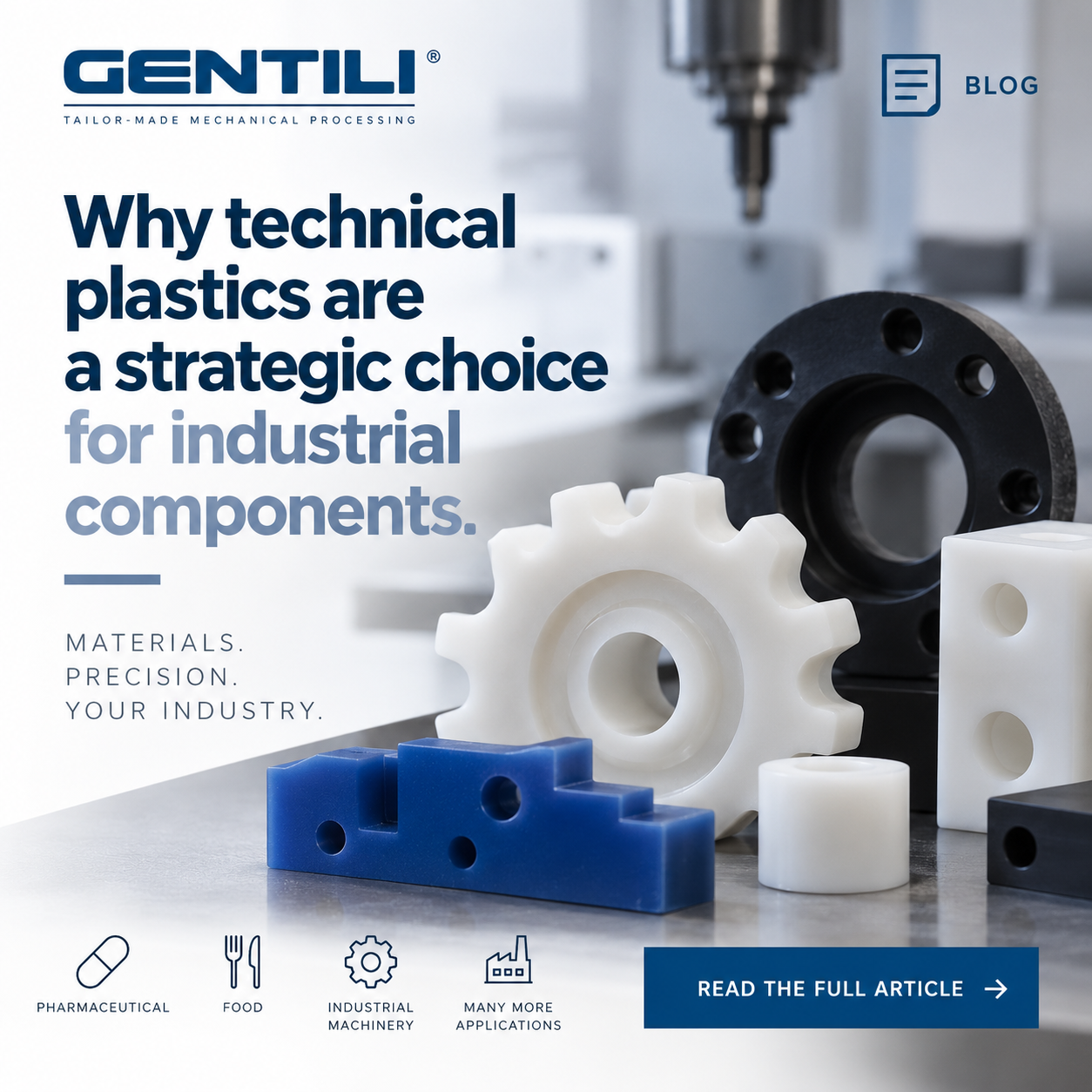
Why technical plastics are a strategic choice for industrial components

Why technical plastics are a strategic choice for industrial components

BLOG 21 January 2026

In modern industrial manufacturing, choosing the right material is not simply a technical decision. It can directly affect component performance, machine efficiency, maintenance requirements and the overall reliability of a production process.

For this reason, technical plastics are increasingly used for industrial components, particularly in applications where low weight, resistance to wear, dimensional stability, chemical resistance or specific friction properties are required.

When correctly selected and precisely machined, engineering plastics can provide an effective alternative to traditional materials and offer manufacturers greater flexibility in the development of customized components.

What are technical plastics?

Technical plastics, also known as engineering plastics, are polymer-based materials developed to provide mechanical, thermal and chemical properties suitable for demanding industrial applications.

Unlike standard plastics used mainly for everyday consumer products, technical plastics are designed to operate as functional components within machinery, production equipment and automated systems.

Depending on the material and application, they can offer properties such as:

  • high mechanical strength;

  • low friction;

  • good wear resistance;

  • resistance to chemicals and corrosion;

  • dimensional stability;

  • electrical insulation;

  • reduced weight;

  • suitability for contact with food;

  • good machinability.

Materials such as POM-C, PA6, PA66, HDPE, PTFE, PET and PEEK can therefore be used to manufacture highly specialized components according to the specific operating conditions of the machine or production line.

Lower weight without compromising functionality

Weight reduction is one of the most immediate advantages offered by technical plastics.

Many engineering polymers have a considerably lower density than metals. Replacing a metal component with a suitable technical plastic can therefore reduce the weight of moving parts and assemblies.

In automated machinery, this can contribute to reducing inertia and simplifying component handling. In some applications, lighter components can also support more efficient machine operation.

The objective, however, is not simply to replace metal with plastic.

The real advantage comes from selecting the material according to the mechanical, thermal and environmental requirements of the application.

Resistance to wear and friction

Industrial machinery often includes guides, supports, sliding elements, spacers, rollers and other components subject to continuous movement.

For these applications, certain technical plastics offer useful friction and wear characteristics.

Materials such as POM, PA or PTFE can be selected for specific sliding or mechanical applications, depending on operating conditions and design requirements.

Using an appropriate technical plastic can help improve component behaviour while reducing the need for additional treatments that may be necessary with other materials.

This makes material selection an important part of the overall efficiency and reliability of the component.

Resistance to chemicals and corrosion

Another important advantage of technical plastics is their resistance to many aggressive environments.

Metal components can be affected by moisture, chemicals or corrosive substances and may require coatings or surface treatments.

Specific engineering plastics, on the other hand, can provide intrinsic resistance to particular chemical agents.

This characteristic makes them particularly interesting for industries where components may be exposed to demanding production environments, including food processing, pharmaceutical equipment, beverage production and industrial plants.

Naturally, chemical compatibility must always be evaluated according to the specific polymer, substance, concentration, temperature and operating conditions.

A wide range of materials for different applications

There is no single technical plastic suitable for every industrial application.

Each material provides a different combination of properties.

POM-C, for example, is widely appreciated for dimensional stability, machinability and mechanical characteristics.

PA6 and PA66 can provide good mechanical strength and wear resistance for many industrial applications.

PTFE is known for its very low coefficient of friction and chemical resistance.

PET can offer good dimensional stability and mechanical performance.

HDPE combines low weight with chemical resistance and is widely used across different industrial environments.

For highly demanding applications, PEEK provides a combination of mechanical, thermal and chemical performance that makes it suitable for specialized components.

The strategic advantage lies precisely in this variety: manufacturers can identify the material whose characteristics best match the actual requirements of the component.

Precision machining makes the difference

Material performance alone is not enough.

Industrial components must also comply with drawings, dimensions, tolerances and functional requirements.

This is why precision machining of technical plastics plays a fundamental role.

Milling, drilling and cutting operations require specific know-how because plastics behave differently from metals during machining. Heat generation, tool selection, clamping and material stability must all be taken into account to achieve consistent results.

Advanced CNC technologies also make it possible to manufacture complex geometries, prototypes, customized components and small production batches while maintaining repeatability and dimensional control.

Technical plastics for highly specialized industries

Engineering plastics are particularly valuable in industries where machines must operate reliably and where each component has a precise function.

Applications can be found in:

  • pharmaceutical packaging machinery;

  • food and dairy processing equipment;

  • confectionery production and packaging;

  • tea, coffee and beverage machinery;

  • woodworking equipment;

  • material handling systems;

  • industrial and energy applications;

  • automated production and packaging lines.

In these environments, the component is rarely a standard item.

It is often a part manufactured according to a customer drawing, developed to fit into a specific machine or assembly.

This makes production flexibility and technical experience particularly important.

Quality, traceability and food industry requirements

For components used in sensitive industrial sectors, material choice and machining quality must be supported by controlled processes and traceability.

Gentili S.r.l. operates under an ISO 9001:2015 certified quality management system, with a focus on process control, traceability, continuous improvement and compliance with customer specifications.

The company also complies with GMP requirements for the machining of plastic materials intended for equipment with food-contact surfaces. Its certified scope includes machining of HDPE, POM-C, PA6, PA66, PTFE, PET, filled PET and PEEK.

These aspects are particularly important when components are intended for food processing and packaging equipment, where consistent quality and documented processes are essential.

From material to tailor-made industrial component

Choosing technical plastics is therefore not simply a question of replacing one material with another.

It means evaluating the component as part of a complete industrial system: its function, operating environment, movement, mechanical stresses, required tolerances and production volumes.

For over 50 years, Gentili S.r.l. has specialized in tailor-made mechanical processing, including milling, drilling, cutting and modelling of technical plastics, phenolic laminates and light alloys.

Starting from customer specifications and drawings, Gentili manufactures customized components and small production series for highly specialized industrial sectors, combining manufacturing experience, CNC technologies and quality control.

The result is not simply a plastic component, but a component manufactured around the specific requirements of the application.

Looking for custom technical plastic components?

Gentili S.r.l. manufactures precision components according to customer drawings and specifications for a wide range of industrial applications.

Contact our team to discuss your project or request a quotation.

© 2026 Gentili S.r.l. - Vicolo della Vecchia 48125 - S.Zaccaria - RA. P:IVA e C.F: 02265840393 | Rea: 186368.

Privacy Policy Cookie Policy

L’azienda nell’anno 2020 e 2021 ha ricevuto aiuti soggetti all’obbligo di pubblicazione nel Registro nazionale degli aiuti di Stato di cui all’articolo 52 L. 234/2012. Designed By Gstudio
  • COMPANY
    • HISTORY
    • CERTIFICATIONS
    • WHO WE ARE
  • PRODUCTION
  • CERTIFICATIONS
  • SUSTAINABILITY
  • BLOG
  • CONTACT