



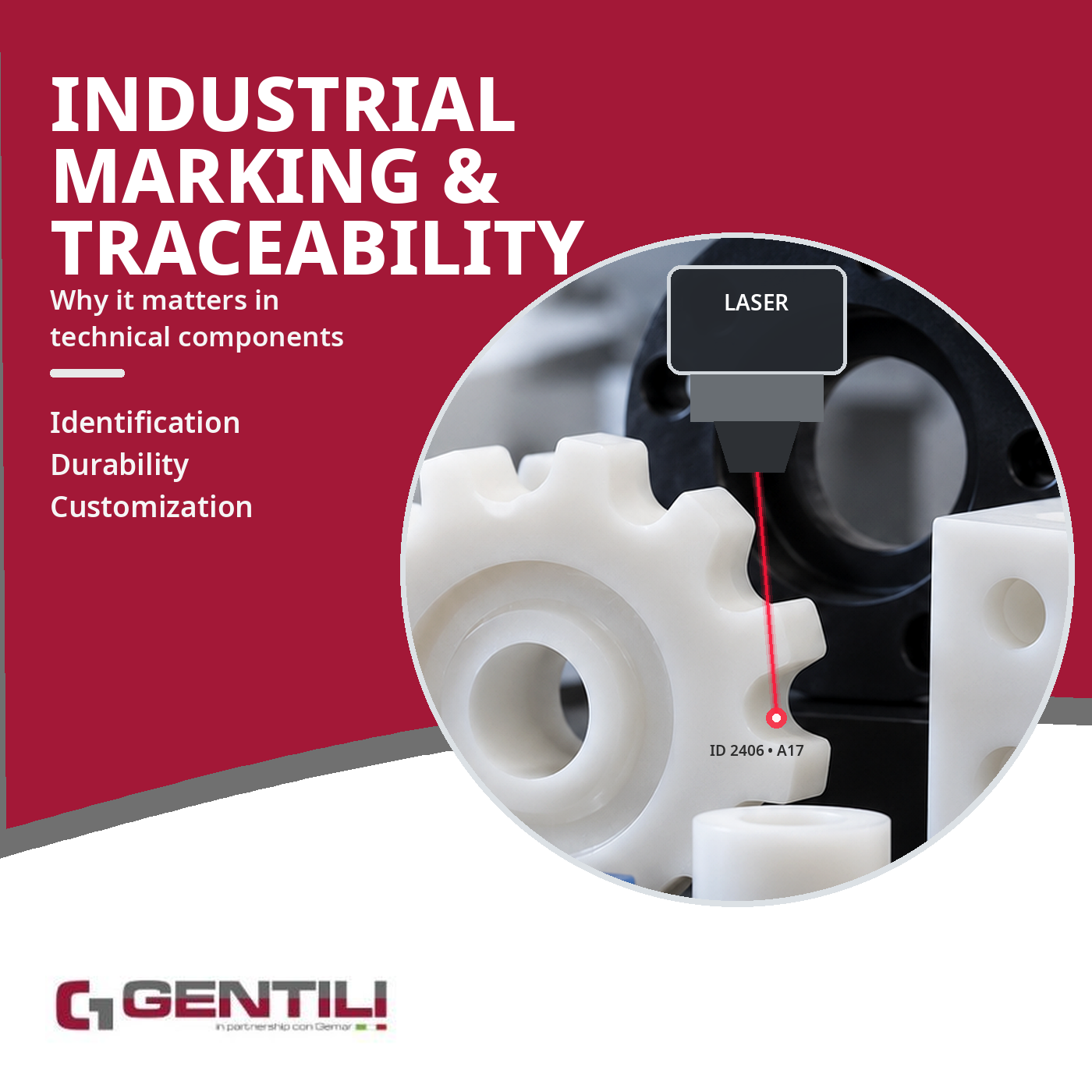
A technical component is defined not only by its geometry and material.
In many industrial applications, it must also be clearly identifiable throughout its lifecycle.
Part numbers, production references, codes, serial information and other permanent markings can help companies manage components from manufacturing and assembly to maintenance and replacement.
For this reason, industrial marking and component traceability are increasingly important elements of technical manufacturing.
Gentili S.r.l. operates a dedicated marking department offering fiber and UV laser marking, CO₂ laser marking and micro-dot marking for technical plastics and light alloys.
Why industrial components need identification
Modern production systems may contain hundreds or thousands of individual parts.
Some may look extremely similar while having different dimensions, materials or functions.
Clear identification helps reduce uncertainty.
Industrial marking can be used to add information such as:
- part numbers;
- internal codes;
- customer codes;
- serial numbers;
- batch references;
- logos;
- symbols;
- technical information;
- assembly references;
- machine-readable codes where applicable.
The specific information required depends on the application and the customer's internal traceability system.
Traceability starts with the component
Traceability is often associated with production databases or documentation.
However, the physical component itself can also play an important role.
A permanent marking creates a direct link between the part and the information associated with it.
This becomes particularly valuable during:
- incoming inspection;
- assembly;
- installation;
- maintenance;
- spare-part management;
- quality investigations;
- component replacement.
Being able to identify a part directly can simplify communication between engineering, production, quality and maintenance departments.
Different materials require different marking technologies
There is no universal marking technology suitable for every material and every application.
The appropriate solution depends on several factors:
- material;
- surface;
- required contrast;
- marking depth;
- component geometry;
- durability requirements;
- production volumes;
- information to be marked.
This is why access to different technologies provides an important advantage.
Gentili's dedicated marking capabilities include fiber laser, UV laser, CO₂ laser and micro-dot technologies.
Each process can address different technical requirements.
Fiber laser marking
Fiber laser systems are widely used for industrial marking because they can create accurate, permanent markings on many suitable materials.
The process is highly controllable and can be used for detailed information, codes, text and identification elements.
For manufacturers, one advantage is the ability to create precise marks without adding labels or separate identification elements.
UV laser marking
UV laser technology can be useful when controlled interaction with the surface is particularly important.
It provides manufacturers with another option when working with materials or applications requiring fine, high-quality marking.
The choice between laser technologies should always be made according to the specific component and material.
CO₂ laser marking
CO₂ laser systems are frequently associated with the processing and marking of non-metallic materials.
For companies working with technical plastics, access to CO₂ technology broadens the range of possible applications.
Again, material compatibility and the required visual or functional result must be evaluated before selecting the process.
Micro-dot marking
Micro-dot — or dot-peen — marking creates identification by mechanically producing a sequence of controlled dots on the surface.
The technique can provide durable industrial identification and is suitable for applications where permanent physical marking is required.
Gentili has continued to invest in this area, expanding its production capabilities with new micro-dot marking equipment.
Why integrated marking matters to buyers
Industrial marking can be performed as a separate operation after a component has been manufactured.
But this can add another step to the supply chain.
The components may need to be:
- manufactured by one supplier;
- packed and shipped;
- received by another supplier;
- marked;
- checked again;
- packed and transported once more.
Each additional handover introduces time, logistics and coordination.
When marking is integrated into the same manufacturing workflow, these steps can potentially be reduced.
Gentili combines machining, inspection, assembly and industrial marking within its production capabilities.
For procurement departments, the advantage is therefore not only technological.
It is also organizational.
Traceability and quality management
Industrial marking becomes even more valuable when combined with a structured quality system.
Gentili operates according to an ISO 9001:2015 certified quality management system, emphasizing process traceability, operational control, continuous improvement and compliance with customer specifications.
In sectors where documentation and component identification are particularly important, these processes support a more controlled supply chain.
For components intended for equipment with food-contact surfaces, Gentili also works in accordance with GMP requirements, where control, traceability and consistent quality are especially relevant.
Marking should be considered during component design
Identification is sometimes addressed only after the component has already been designed.
A better approach is to consider marking during the design and industrialization stage.
Technical teams can evaluate:
- where the marking should be positioned;
- how large it must be;
- whether the surface is suitable;
- how the component will be oriented;
- what information must remain visible after assembly;
- which technology is compatible with the material.
This helps avoid unnecessary complications later in the production process.
A small detail with a major operational value
Industrial marking may occupy only a few millimetres of a component.
Its value, however, can extend throughout the entire lifecycle of the product.
Effective identification supports traceability, maintenance, quality management and efficient communication between different departments.
For manufacturers and buyers, integrating marking into the production process can also reduce supplier complexity and additional handling.
Do your components require permanent identification?
Gentili S.r.l. combines precision machining with fiber laser, UV laser, CO₂ laser and micro-dot marking technologies.
Contact our technical team to evaluate the most appropriate solution for your component.