



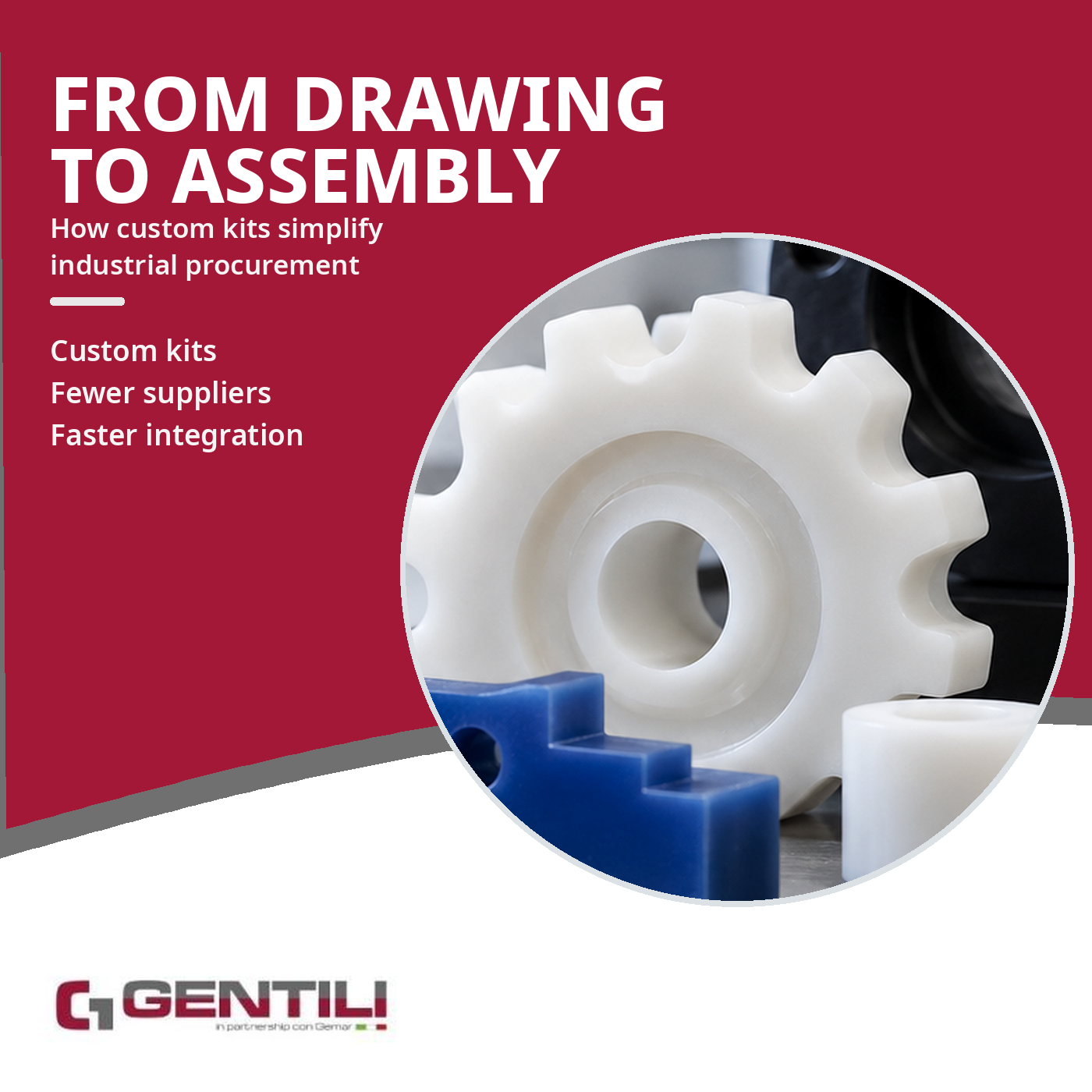
For industrial buyers, purchasing individual components is only one part of managing the supply chain.
A project may involve several machined parts, different materials, quality inspections and final assembly operations before the components are ready to enter the production line.
Every additional supplier and every additional handover creates another activity to manage.
For this reason, custom kit assembly can offer significant advantages when technical components need to arrive as a coordinated, ready-to-integrate solution.
Gentili S.r.l. combines customized machining with assembly capabilities for plastic and metal kits developed according to customer specifications.
The limits of component-by-component procurement
Consider a technical assembly made from several custom components.
The purchasing department may need to source different parts, monitor delivery dates, verify incoming products, manage inventory and coordinate internal assembly.
The engineering team may then need to confirm that all components fit correctly together.
When several suppliers are involved, complexity increases further.
Potential issues include:
- different production lead times;
- multiple purchase orders;
- separate shipments;
- duplicated quality controls;
- component compatibility problems;
- increased inventory;
- greater administrative work.
None of these activities adds direct value to the finished machine.
They are necessary because the supply process has been fragmented.
From individual component to customized kit
A custom kit changes the approach.
Instead of treating every part as an independent purchase, several components are managed as elements of the same technical requirement.
The supplier can manufacture, control and assemble them according to the customer's specifications.
Gentili has dedicated production areas for milling, drilling, cutting, assembly and quality control, as well as assembly benches for customized kits.
This creates a more integrated workflow from technical drawing to finished assembly.
One technical drawing, one controlled process
The process begins with the customer's specifications.
Different components may require different materials, manufacturing methods and tolerances.
For example, a kit might combine:
- technical plastic parts;
- light-alloy components;
- machined plates;
- supports;
- spacers;
- guides;
- fasteners or complementary elements.
Each component can be manufactured individually and then brought together during the assembly stage.
The advantage is that compatibility can be evaluated before the complete kit reaches the customer.
Fewer supplier handovers
Supplier consolidation is one of the most important potential benefits for procurement departments.
Imagine a project requiring five custom components.
If the parts are managed separately, the buyer may need to coordinate several orders or suppliers.
When manufacturing and kit assembly are integrated, the customer can manage a broader part of the requirement through a single technical relationship.
This can reduce:
- purchase-order complexity;
- supplier coordination;
- transport between suppliers;
- incoming logistics;
- internal handling;
- communication steps.
The result is a simpler supply chain.
Assembly can reveal problems earlier
There is another important advantage.
When components are assembled before delivery, compatibility problems can potentially be detected earlier.
Two parts may individually meet their dimensional requirements but still require careful evaluation when they interact within an assembly.
Integrating machining, dimensional inspection and assembly makes it possible to consider the components as part of a complete system.
Gentili's production organization combines customized machining, digital quality inspection, marking and assembly within dedicated production areas.
Supporting leaner production lines
Custom kits can also help customers simplify their internal processes.
Instead of receiving several separate component references, the production department may receive a coordinated group of parts ready for the next assembly stage.
This can potentially reduce:
- picking activities;
- internal transport;
- component sorting;
- intermediate inventories;
- assembly preparation.
The exact benefits depend on the customer's production system, but the principle is straightforward:
move selected operations upstream to a specialized supplier so that the customer's production line can focus on higher-value activities.
Flexibility matters in small-series manufacturing
Kit assembly is particularly relevant when production requirements are customized or volumes are limited.
Mass-production supply chains are usually built around highly standardized operations.
Technical machinery manufacturers often work differently.
They may require:
- prototypes;
- customized components;
- project-specific assemblies;
- small production batches;
- recurring but variable quantities.
Gentili describes its manufacturing model as flexible and focused on technical components and small-series production for specialized industries.
This type of organization makes it possible to adapt the workflow according to individual projects.
Quality control before assembly
A kit is only as reliable as the components inside it.
For this reason, dimensional inspection remains an important part of an integrated production process.
Gentili's Quality Control 4.0 department uses digital inspection technologies including a precision digital height gauge and a three-dimensional measuring arm.
Verification before or during assembly can help ensure that the individual components meet the requirements defined by the project.
Gentili's ISO 9001:2015 quality management system also supports process control and traceability throughout production.
A procurement decision, not just a manufacturing decision
The value of custom kit assembly is therefore not limited to production.
It can also affect the purchasing strategy.
When evaluating a supplier, procurement departments should consider not only the price of individual parts but the total effort required to obtain a usable assembly.
That includes:
- supplier management;
- logistics;
- inspection;
- inventory;
- internal assembly;
- administrative work;
- risk of mismatched components.
A supplier capable of managing more stages of the process may help reduce this complexity.
From drawing to ready-to-integrate solution
The most effective industrial supply relationships go beyond simply delivering components.
They start with an understanding of the technical requirement and build the production process around it.
Gentili combines custom machining, prototyping, quality control, marking and kit assembly for technical plastics and light alloys.
For customers, this provides the possibility of moving from a series of individual purchases toward a more coordinated manufacturing solution.
Can your component supply be simplified?
Gentili S.r.l. manufactures customized components and assemblies according to customer specifications.
Send us your drawings and technical requirements to evaluate a tailored production and assembly solution.