



Selecting a manufacturing supplier involves much more than comparing quotations.
For technical and procurement departments, the real question is whether a supplier can consistently manufacture the required component, control the process, adapt to changing requirements and provide reliable support throughout the relationship.
In customized industrial manufacturing, three factors are particularly important:
precision, traceability and flexibility.
Together, they provide a useful framework for evaluating a potential manufacturing partner.
1. Precision: can the supplier reproduce the drawing?
Every sourcing process begins with a technical requirement.
The manufacturing supplier must be able to translate that requirement into a physical component while respecting:
- geometry;
- dimensions;
- tolerances;
- material specifications;
- surface requirements;
- functional characteristics.
Machine technology is clearly important.
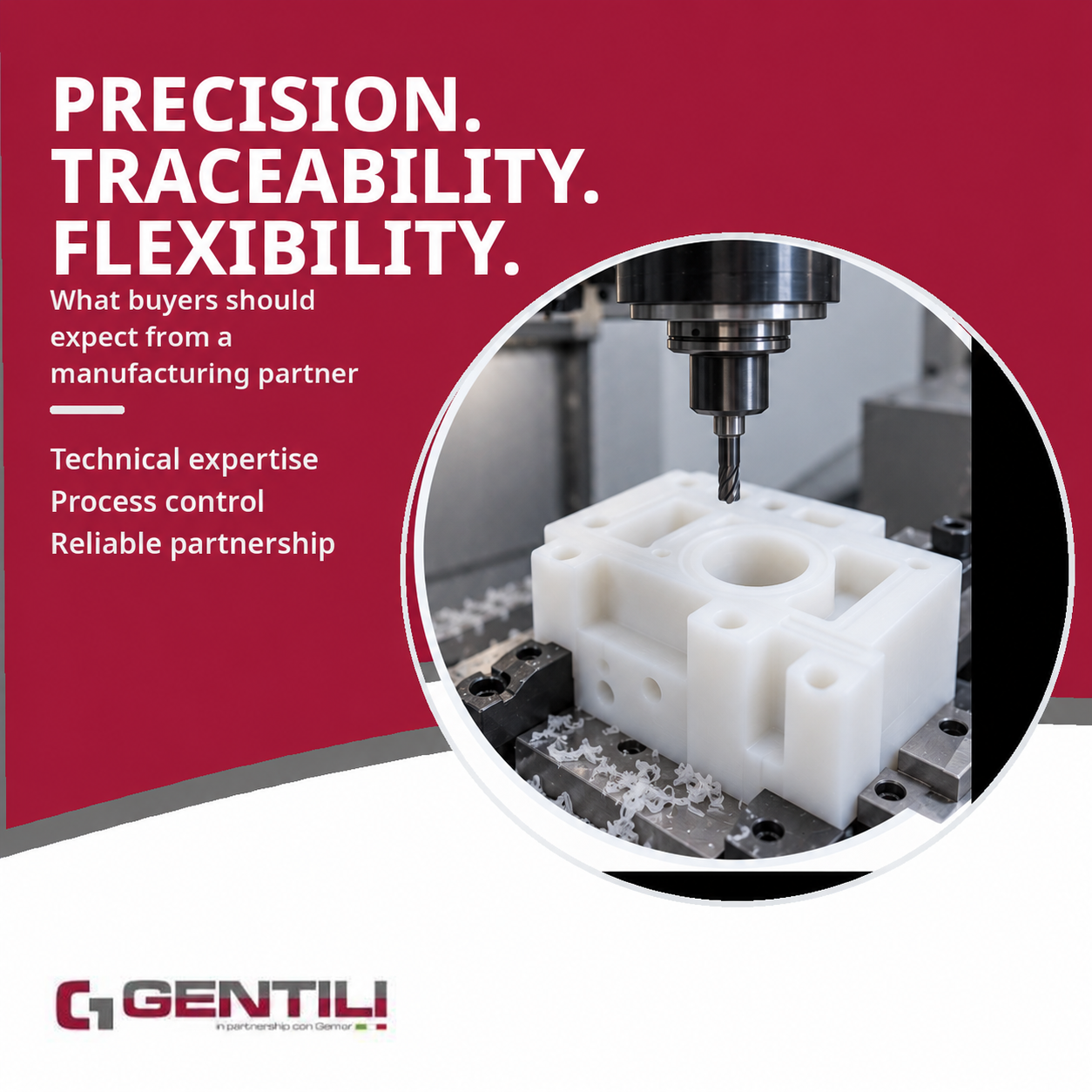
Gentili's production equipment includes 3-, 4- and 5-axis CNC machining centres for customized components in technical plastics, phenolic laminates and light alloys.
But machining equipment alone does not guarantee precision.
The process must also consider tooling, workpiece positioning, machining strategy and material behaviour.
This is particularly relevant when working with technical plastics, which require specific manufacturing expertise.
Precision must be verified
For a buyer, the manufacturer's claim of precision is less important than its ability to verify it.
This is where quality control becomes essential.
Gentili uses Quality Control 4.0 equipment including a high-precision digital height gauge and a 3D measuring arm to support dimensional verification of manufactured components.
Digital inspection helps create a more structured relationship between the technical drawing and the finished component.
For procurement and engineering teams, this reduces uncertainty.
2. Traceability: can the component be identified?
Industrial supply chains increasingly require reliable identification.
A technical component may remain in service for years.
During that period it may need to be inspected, replaced, reordered or associated with technical documentation.
Traceability supports these activities.
Gentili operates a dedicated industrial marking department with fiber and UV laser, CO₂ laser and micro-dot marking technologies.
Permanent identification can support:
- component recognition;
- part-number management;
- maintenance;
- batch management;
- spare-parts operations;
- internal quality procedures.
Traceability therefore connects manufacturing with the entire lifecycle of the component.
Process traceability matters too
Traceability is not limited to physically marking a part.
It also involves the way the manufacturing process itself is managed.
A structured quality system helps ensure that specifications, procedures and controls are handled consistently.
Gentili operates under an ISO 9001:2015 certified quality management system, which supports rigorous process control, continuous improvement and traceability.
For buyers, this is particularly important when the supplier relationship becomes recurring rather than limited to a single order.
3. Flexibility: can the supplier adapt?
Not every industrial project follows a predictable pattern.
Volumes change.
Drawings evolve.
Prototypes become small production batches.
Components may require modifications.
New materials or additional operations may become necessary.
For companies operating in specialized industries, manufacturing flexibility can therefore be just as important as production capacity.
Gentili's organization is focused on tailor-made mechanical processing, technical components and small-series production.
The company's production capabilities include:
- milling;
- drilling;
- cutting;
- prototyping;
- multi-axis CNC machining;
- quality control;
- industrial marking;
- customized kit assembly.
This range of capabilities makes it possible to organize the production process around the requirements of the project.
Look beyond the individual machine
When evaluating a supplier, it can be tempting to focus exclusively on its machinery.
Which CNC centres does it have?
How many axes?
What technology does it use?
These are important questions, but they provide only part of the answer.
A manufacturing partner should also be evaluated on how its different processes work together.
For example:
Machining + inspection
Can the supplier manufacture the component and verify critical dimensions?
Machining + marking
Can identification be integrated without involving another supplier?
Machining + assembly
Can several components be supplied as a coordinated kit?
Prototyping + small batches
Can the supplier support the project as requirements evolve?
The more effectively these activities are coordinated, the easier the overall supply relationship can become.
Fewer handovers, more control
Every additional production step managed externally can create another supplier interface.
For purchasing departments, that means additional:
- quotations;
- orders;
- deliveries;
- controls;
- logistics;
- administration;
- communication.
Consolidating compatible activities within one manufacturing partner can simplify this chain.
Gentili has dedicated areas for milling, drilling, cutting, assembly and quality control and integrates these operations within a tailor-made production approach.
The advantage is not simply convenience.
It can provide greater continuity from drawing to finished component.
Technical communication is part of the service
A good manufacturing relationship also depends on communication.
Buyers and engineers need a supplier capable of understanding:
- drawings;
- functional requirements;
- critical tolerances;
- production quantities;
- application constraints;
- required documentation.
This becomes especially important when manufacturing customized parts.
An efficient supplier relationship should help identify potential production issues before they become problems.
For this reason, technical responsiveness should be considered alongside price and lead time when qualifying a new partner.
Quality and responsible production
Today, companies are also increasingly looking at how suppliers manage their wider responsibilities.
Gentili publishes an annual Sustainability Report and states that its sustainability approach covers people, ethical relationships with customers and suppliers, continuous improvement and reduction of the environmental impact of its manufacturing processes.
The company also describes an ongoing path toward reducing its carbon footprint and strengthening its environmental-management approach.
For procurement teams, these elements are becoming increasingly relevant when evaluating long-term supply relationships.
What should a buyer ask?
When qualifying a manufacturing supplier, a useful checklist includes:
- Can you manufacture the required geometry?
- Which materials do you regularly machine?
- How are critical dimensions inspected?
- Can components be permanently identified?
- How do you manage traceability?
- Can you support prototypes and small batches?
- Can you manage component assembly?
- Which quality-management standards are in place?
- How are changes to specifications handled?
- Can several operations be managed within the same production workflow?
Price remains important.
But these questions help determine the real value and risk of the supply relationship.
From supplier to manufacturing partner
The strongest industrial relationships are not based on a single purchase order.
They are built when the supplier understands the customer's technical requirements and can provide consistent support as those requirements evolve.
Precision ensures that the component meets its specification.
Traceability keeps the component and its process identifiable.
Flexibility allows production to respond to changing needs.
Together, these capabilities help transform a conventional supplier into a reliable manufacturing partner.
Gentili S.r.l. has provided tailor-made mechanical processing since 1974, combining more than 50 years of manufacturing experience with specialized production technologies for technical plastics, phenolic laminates and light alloys.
Looking for a manufacturing partner for your next project?
From prototypes and small batches to complex components, marking, inspection and customized assemblies, Gentili builds the production process around the customer's technical requirements.
Send us your drawing or request a technical evaluation.